
Les explains the difference between the traditional four-year program and the modern two-year program for taking a two-year-old horse from the snaffle bit to the bridle.
In addition to discussing the process, Les objectively shares his experience using both programs.

Two Year or Four Year
Bridling a horse in the reiner – or contemporary – style takes the two-year-old horse from a snaffle bit horse to a bridled horse basically in two steps. So what is the difference between this and the traditional Californio style of bridling and why choose one or the other?
The difference between the traditional method of bridling the horse versus the reiner method is comparable to a student attending a two year college versus a four year college. The student who attended the four year college is not necessarily brighter than the other but due to having four years of education he is supposed to be able to deal with many different circumstances.
The four year student should have had exposure to more information, just like our traditionally bridled horse.
In the reined work itself which consists of a series of high-performance maneuvers – stops, spins, circles, lead changes and possibly rollbacks – there is not a lot of difference between the reiner schooled horse or the traditionally schooled horse. Some of the horses who have been to two year schools are extremely competitive on any level.
Reining futurity horses have some of the greatest reined work that you’ll ever see, you won’t see even more experienced reined cow horses that are better than these youngsters. In fact the straight reining style has bled over to the reined cow horse and reined cow horse has adapted the reining horse scoring system. This means the horse that has a very high score in a straight reining competition would have an equal score in a reined cow horse pattern.
The reverse should also be true; the horse that scores well in the reined cow horse should also score well in a reining competition.
A horse that is destined to be a reined cow horse will probably benefit from being a four year schooled horse. For one thing I have found that my own horses don’t really reach their full potential until they are around eight years old. Also, I think the horse who goes through the traditional method of bridling is more durable simply because it allows him that much more time to mature physically and mentally.
In addition to the reined work, the reined cow horse is required to run down the fence at top speed to control a cow under difficult circumstances. That means that he has to stay in a position of control advantage no matter where the cow goes. He also has to be in a position that the cow should respond to in a positive way so that he can get the turns he wants on the fence.
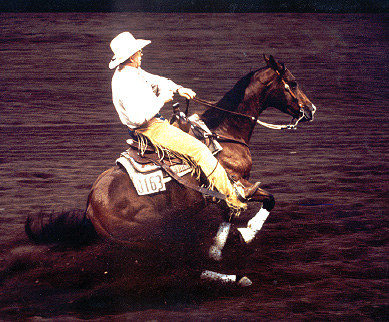
Two year vs. four year? Both do high quality reined work
Maneuvering the horse with that much speed requires that the horse is ‘user-friendly’. This means that the rider should be able to pick the horse up and rein him across the neck without force. The horse has to be responsive at high speed and short notice to changes of speed and changes of direction.
The reined cow horse always has to be in the correct position in his turns – ribs out, shoulders out with his head to the interior of the turn. Form has always been very important in a reined cow horse whether it’s a long rolling turn or a short, tight turn on the fence.
The cow work is fairly explosive. A horse that is as user-friendly as I like has usually been to the four year school. He has to be really responsive and have a clear understanding of being in the bridle. The cow work rather than the reined work is the real barometer of the horse’s education.
A horse who is going to be a straight reining horse would typically not be a four year horse. He would be a two year project.
The Two -Year-Horse (Reining Horse Method)
OK, we have our project horse and we are going to train him using the reiner method. We will start him in the snaffle bit in the spring of his two-year-old year and move him into a short-shank (7 inches or less) or Argentine type snaffle as soon as he has learned strong fundamentals, which means he should be able to demonstrate body control with a lot of confidence.
I prefer to introduce the Argentine to my horse late in his two-year- old year because I know that in today’s show pen the bar is set so high that I can’t train him to do everything in a plain snaffle. I introduce him to the leverage bit at the end of a ride when he’s been working really well in the snaffle. I’ll take some quiet time after the work session, put the Argentine on him, and just ride him around. This lets him familiarize himself with the bit without pressure.
We don’t want to overdo the pressure on our prospect but we do have to find out if he’s a good student. The horses that want to be good learners will rise to the occasion while others resent the pressure. We need to find out which one our horse is before we waste too much more time.
The Three Year Old
If all our work has gone according to plan it is time to teach our horse to neck rein. I like to start working on this right after the first of the year when the horse is officially a three-year-old. If your goal for this horse is a futurity which takes place late in the year that gives you eleven months to get him ready. The first step toward getting him ready is to teach him to neck rein as early as possible.
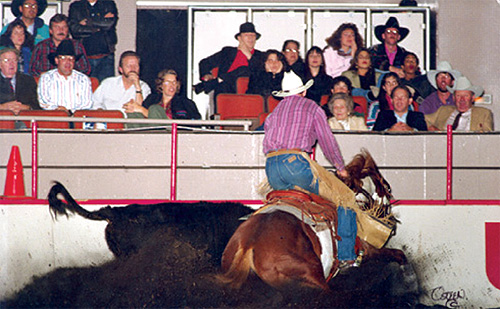
The reined cow horse has to control the cow under difficult situations
We teach the horse to neck rein in the same way that I discussed in another article. The real definition of bridling a horse as far as I’m concerned is, “Will he neck rein and stay in the bridle”? I should be able to lay my rein softly across the horse’s neck at a standstill and have him bend his nose around to the toe of my boot. And he should do this equally well on both sides.
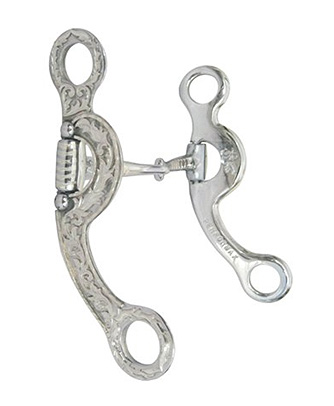
The horse can be introduced to the Argentine late in his two-year-old year.
Our goal is to introduce the Argentine, in order to do this we have to educate the horse. If we just lay our rein across his neck, he has no real idea what we want. We start at the walk and lay the right rein against the horse’s neck then take the left rein and give him an educational pull to the left, if he doesn’t turn his head to the left when he feels the rein touch him. Match the pull on the left rein with leg pressure from the left boot top to encourage him to flex and bend to the inside. Repeat this exercise to both sides.
For the horse to really understand this exercise, it should be done repeatedly every day, as it will determine the end result. This is one of those exercises that you can do over and over again without hurting the horse physically or mentally. As with all our exercises, the release of the pressure is the reward.
When practicing this you will want to get your horse to the point where he really bends about 90 degrees. The reason we want to get him to bend around this much is that when he is under pressure you will probably get about half of that which will be just about right. It is important to remember that this exercise is not to teach the horse to change direction but to bend his head from side to side.
The reiner horse will be ready to graduate as soon as you feel like you need a little stronger bridle to avoid confusion and maintain respect. You should never upgrade to a more sophisticated bit to force the horse into anything.
However, we don’t want him to lose respect for the bridle either. Once the horse starts to lose respect in the bridle it can be hard to regain it. There’s a fine line between the ultimate in respect for the bit and fearing the action of the bit. We have to be very careful to keep the respect level high without getting into the fear. If you feel the horse is becoming afraid then back off, if you feel the horse is losing respect then that is the time to move him into a more refined bit.
You should not allow the horse to have a problem in his training due to lack of respect for the bit. Letting the horse have bad days is not only counter-productive but can affect his confidence in his ability to perform the maneuvers. If we can put him into a better bit, a little higher level bit, before he learns he can run through a milder one then we have a peaceful transition. I feel it is very wrong to wait until you have a bad day or days and then put a bigger, stronger, bit in his mouth.
You’ve already got problems and then you put a bit on him that he doesn’t understand to resolve them by force; it’s just not going to work. In fact your problems will probably multiply. Wait until you have sorted out the difficulties and things are back on the right track. Then you can try a higher level bit and you can educate him without conflict.
Teach the horse how to respond to a bit upgrade before you have a problem. One of the most common flaws in bitting is that people wait until they are having trouble and then they introduce something that the horse considers more severe. That’s when you get into the fear factor and that’s when it shows up in the horse as temper. It’s a big problem and it’s hard to erase.
We have reached the point where we are ready to graduate from the Argentine bit to a more sophisticated bit. You may have an idea about the bit you would like to end up with but you have to take gradual steps to get there. The next step up from the Argentine is a bit with swivel cheeks, leverage (how much will depend on your horse’s needs), and more mouth power (again depending on your horse.)
.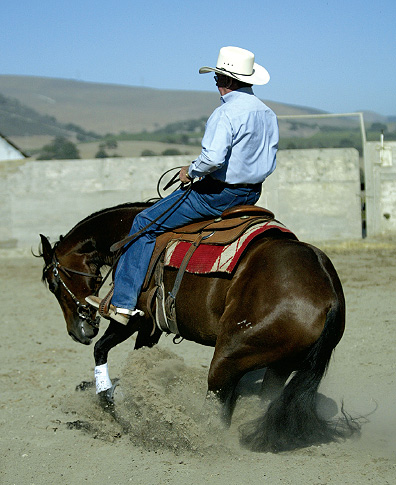
The horse should be executing all the maneuvers at a fairly high level before moving to a more sophisticated bit
We’ve talked quite a lot about leverage and mouthpiece power and what it does in previous articles but here is a brief re-cap: higher leverage will encourage the horse to drop his neck while lower leverage will help to raise the shoulders.
Mouthpiece power depends on how soft or hard your horse is in the mouth. Again, you want a mouthpiece that the horse respects and can understand without being afraid of it. Once you’ve made your bit choice you introduce it to him in the same way as the Argentine. After a good work you put the leverage bit on him and just ride around.
With this in mind we should be able to figure out what bit our horse will respond to best in the show pen. We may also choose a bit especially for showing. Some people use the same bit at home as at a show, they want the horse to have the respect for the bit because they’ve schooled with it. They want the horse to know that the bit can demand his attention.
I disagree with this method although many people are successful with it. I choose a show bit from the one or two bits that have come to the top of the list through trial and error with this particular horse. I will educate him to these bits very slowly. I want him to be very comfortable with them and I want to be comfortable with them too. I want a really good feeling between us with this particular communication tool. I might have as many as two or three bits that I think are going to fit my needs when I show this horse.
I will test the horse in the Argentine bits too, giving him some serious schooling because I want to make sure that things hold together with any potential show bit before you get in the show pen. But I will not use these bits for my every day training. I’ll only use them for an occasional test or for riding casually either outside the arena or while doing soft, fundamental drills after a work session. I want the horse to be comfortable and bright in that bit. The theory behind my method is that I feel I haven’t used up the respect the horse has for the chosen show bit..